One really nice feature of Ballynahinch Castle is that checkout isn’t until noon.
And we took full advantage of it!
After yesterday’s exploring, we had a lazy morning and eventually met up around 9:00 for breakfast.
The breakfast area at Ballynahinch consists of several beautiful rooms at the back of the castle overlooking the river. One of the rooms has a sitting area and, of course, another huge fireplace.
Seriously, I wonder how many fireplaces this place has?
There was also a large buffet filled with cheeses, fresh fruit, pastries, meats, yogurts, cereals, jams and jellies and even fresh honeycomb.
We considered these our breakfast appetizers.
Because apparently that’s a thing now.
Once you’ve stuffed yourself with all of those goodies, you move on to the actual breakfast menu and order a full breakfast made to order.
I chose the brioche French toast with bacon and fresh fruit, while the others opted for omelets with mushrooms, spinach and ham.
And once again, no one was disappointed.
Or hungry.
Definitely not hungry.
After breakfast, the boys decided to take advantage of our rooms for the last hour or so.
Kelly and I had a different idea.
Shopping. 😉
We took a little walk and managed to satisfy our retail needs before heading back to our room for one final pack-up.
Then it was time to say goodbye to our little taste of castle life and start making our way north toward Westport.
But we had a few stops planned along the way.
Up Into the Sky
First up was Sky Road, just outside the town of Clifden.
Sky Road is a roughly 10-mile scenic loop that winds high above the Connemara coastline. The road climbs more than 500 feet above sea level in places, giving you incredible views over Clifden Bay, the Atlantic and several offshore islands.
And yes, it’s another one of those Irish roads that makes you occasionally wonder if two cars are actually supposed to fit on it.
Apparently they are.
We’ve stopped questioning these things.
The higher we climbed, the better the views became—rocky coastline, little islands, green fields divided by stone walls and the Atlantic stretching out in front of us.
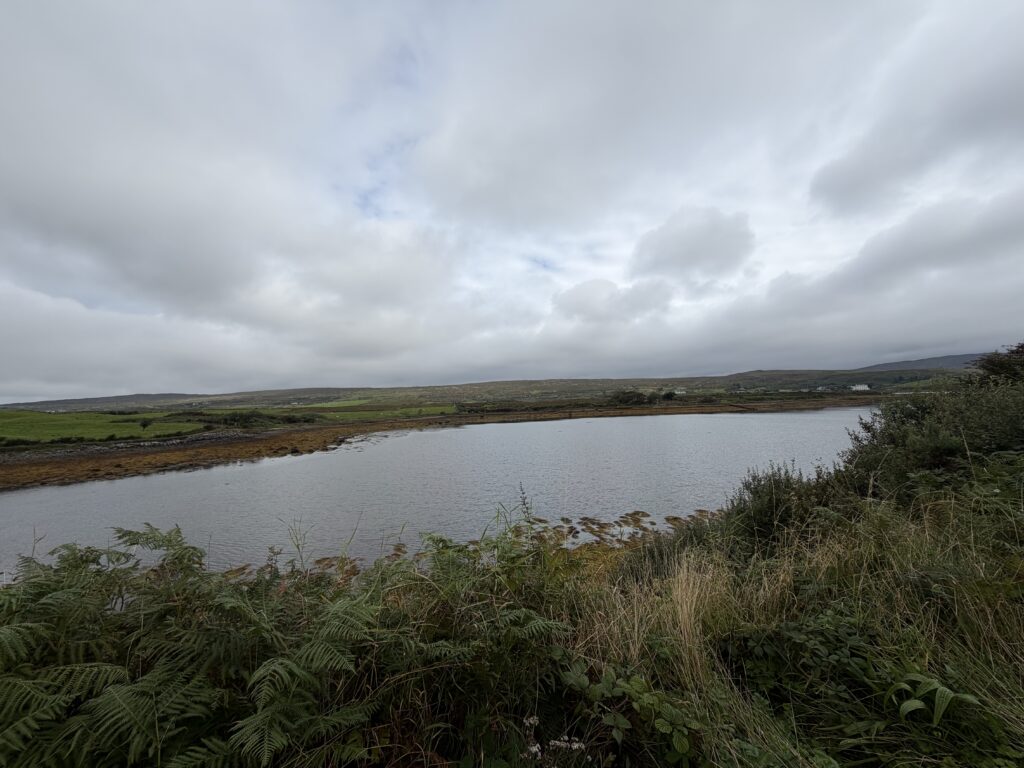
At the highest point there’s an overlook where you can really take it all in.
Another one of those places where pictures just don’t quite capture how beautiful it is.
After finishing our drive along Sky Road, we continued toward our next stop.
Kylemore Abbey
And then we saw it.
Kylemore Abbey.
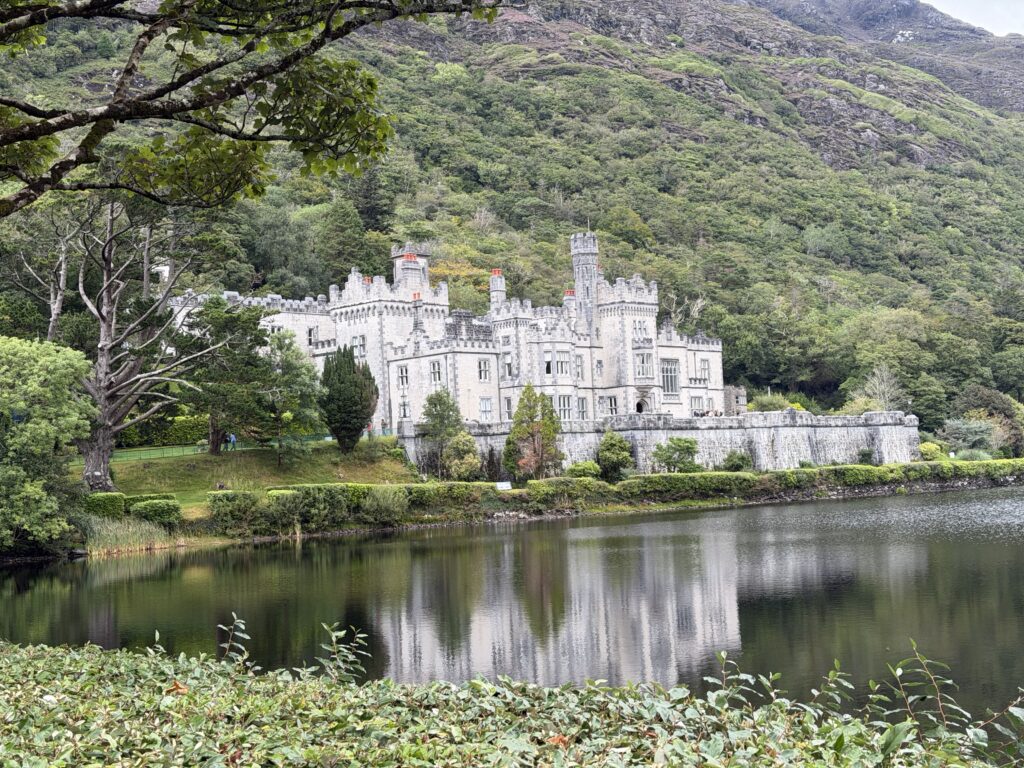
To say this is a beautiful setting would be an understatement.
It’s absolutely stunning.
The abbey sits right at the base of the mountains along the shore of Pollacapall Lough, surrounded by woodland and reflected in the lake in front of it.
It almost doesn’t look real.
The entire Kylemore estate covers around 1,000 acres, surrounded by the mountains, lakes and bogs that make Connemara such a spectacular part of Ireland.
And once you learn the story behind the building, it becomes even more interesting.
Kylemore wasn’t originally an abbey at all.
It was a castle built for love.
Mitchell Henry was a wealthy doctor, businessman and politician who first visited Connemara with his wife, Margaret Vaughan Henry, in the 1850s. They fell in love with the area, and after Mitchell inherited his family’s fortune, he purchased the property.
Margaret laid the foundation stone for Kylemore Castle in 1867, and the castle was completed a few years later as a home for Mitchell, Margaret and their large family.
And when I say large…
They had nine children.
The castle itself was pretty impressive for its day—33 bedrooms, four bathrooms, four sitting rooms, a ballroom, billiard room, library, study, schoolroom, smoking room and gun room.
Apparently the Henrys weren’t exactly roughing it in Connemara.
But one of the things we learned about Mitchell that I found most interesting was that his vision for Kylemore went far beyond building a beautiful home for his family.
Connemara was still suffering terribly from the effects of the Great Famine. There was widespread poverty, very little employment and extremely difficult living conditions.
Mitchell was considered a very different kind of landlord for his time. He believed the people who lived and worked on his estate should be treated with dignity and respect, and he wanted Kylemore to improve life not just for his own family, but for the people living throughout the area.
Building the castle itself provided much-needed jobs, but he didn’t stop there. He provided housing and employment, opened a school for the children of his workers and encouraged new farming methods that could help local farmers become more productive.
Much of the land around Kylemore was bog, so Mitchell began experimenting with ways to drain and reclaim it. Over the years, previously unusable land was turned into productive farmland, and Kylemore became something of an experiment to show what could happen when the land—and the people working it—were given a chance.
One thing Emma told us that really stuck with me was the way Mitchell dealt with his tenants during bad farming years.
When crops were poor, instead of insisting that his tenants somehow come up with their rent anyway, he suspended their rent payments. His belief was that if the losses were caused by circumstances beyond anyone’s control, the landlord should share in those losses too.
For a wealthy landowner in the 1800s, that seems pretty progressive.
Mitchell eventually represented Galway in Parliament for 14 years, where he continued advocating for tenant welfare and became one of the early supporters of the Irish Home Rule movement.
The more we learned about him, the more interesting he became. He certainly enjoyed the advantages his wealth provided—just take a look at the house he built!—but he also seems to have believed that having that wealth came with a responsibility to improve the lives of the people around him.
Kylemore wasn’t just his home. In many ways, it was his attempt to show what an entire community could become when people were treated fairly and given opportunities to improve their lives.
As we pulled into the parking lot, so did what seemed like about 20 tour buses.
It was Saturday.
We should have known.
The place was definitely busy, but surprisingly, the crowds never really bothered us.
We checked the schedule and saw that the next history talk wasn’t for about an hour, so we decided to use the time to walk along the lake toward the Gothic Church and mausoleum.
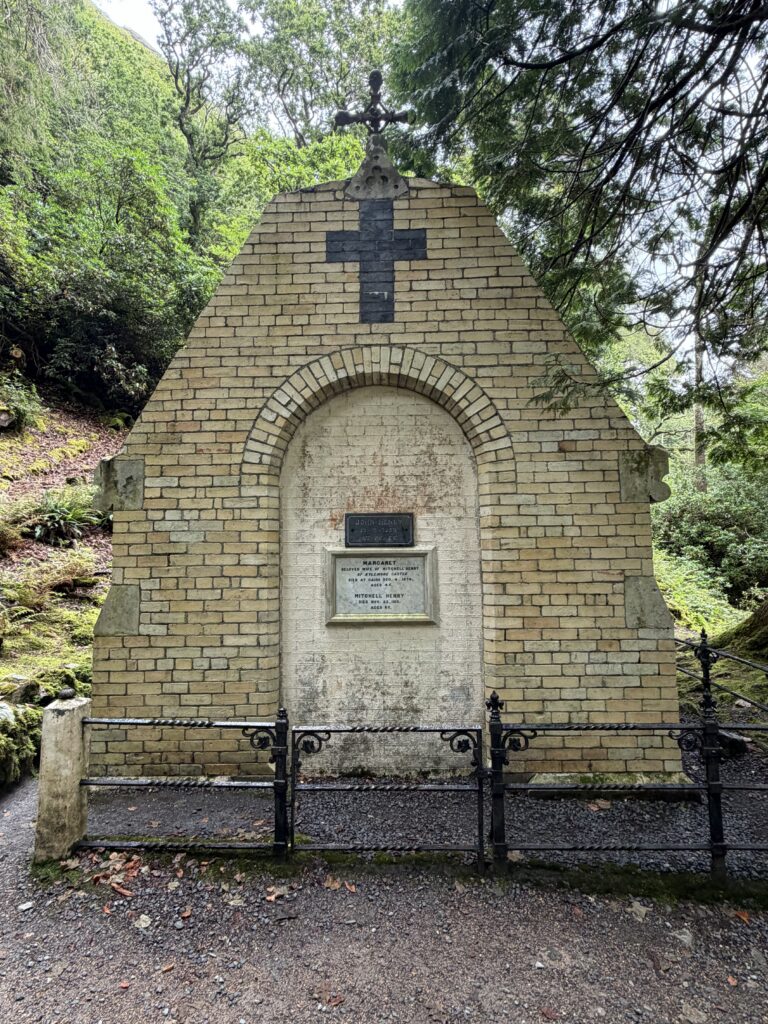
And this is where the story of Kylemore becomes a love story—and a very sad one.
In 1874, Mitchell and Margaret were traveling in Egypt when Margaret became ill with dysentery.
She died just 16 days later.
She was only 45 years old.
Mitchell was devastated.
Margaret’s body was embalmed in Cairo and brought all the way back to Kylemore, where she was eventually laid to rest in a small mausoleum tucked into the woods.
Mitchell then built the beautiful neo-Gothic Church nearby as a memorial to his wife.
It’s sometimes described as a “cathedral in miniature,” and that’s exactly what it looks like.
But there are some really beautiful details inside.
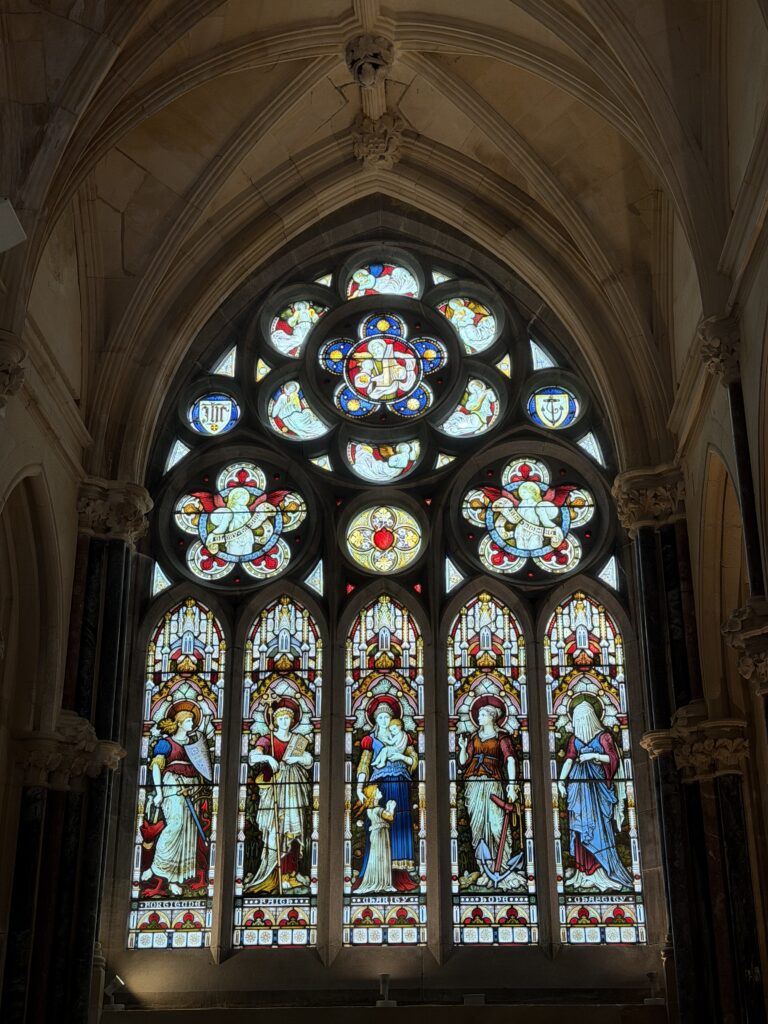
Instead of the scary gargoyles you might expect on a Gothic church, the carvings include flowers, birds and angels. The interior also has marble columns made from marble from four different parts of Ireland—green Connemara marble, black Kilkenny marble, red Cork marble and white marble from Tyrone.
The church was Mitchell’s lasting tribute to Margaret.
Just a short distance away is the much simpler brick mausoleum where Margaret was buried.
When Mitchell died in 1910, he was brought back to Kylemore and buried beside her.
After everything he’d built for her, they’re still together here more than a century later.
Pretty romantic, don’t you think? ❤️
Our timing worked out perfectly. By the time we made our way back to the abbey, we had just enough time to look around a few of the rooms before meeting our guide, Emma.
And did we ever luck out with her.
Emma talked with us for more than an hour about the history of Kylemore, the Henry family and all the changes the estate has gone through over the years.
After the Henry family left, Kylemore was sold in 1903 to the Duke and Duchess of Manchester. The Duchess was actually a wealthy American heiress, and apparently there were plenty of colorful stories surrounding the couple during their time here.
But the biggest change came in 1920, when a community of Benedictine nuns arrived at Kylemore.
Their own story is pretty remarkable.
The community had been based in Ypres, Belgium, but their abbey was destroyed during World War I. After fleeing Belgium, they eventually found their new home here in Connemara.
That’s when Kylemore Castle officially became Kylemore Abbey.
Three years later, in 1923, the nuns opened a girls’ school here. It eventually became a well-known international boarding and day school, with girls coming from Ireland and countries around the world.
The school remained open until 2010.
And that’s where Emma’s own story made our tour even more special.
She grew up right here in the area. Her ancestors were directly involved with Kylemore and its history, and as a young girl, Emma herself attended the school run by the Benedictine nuns.
So she wasn’t just telling us a story she’d learned for her job.
This was her history.
You could hear it in the way she talked about the families, the people who worked here and the community surrounding Kylemore. She was extremely knowledgeable, but more than that, she was genuinely proud of her heritage and the role her family had played in this place.
Those are the kinds of people you remember from a trip.
We ended up spending most of the afternoon at Kylemore, and I’m glad we gave ourselves the time. Between the setting, the buildings and all that history, there was a lot more to this place than we expected.
Eventually, though, it was time to get back in the car.
Next stop…
Westport.
And thankfully, it was only about another hour away.
I’m pretty sure everyone in the car was happy about that!
We reached Westport and our Airbnb around 5:00, got ourselves settled and then headed back out in search of dinner and, naturally, a few drinks.
We found JJ O’Malley’s, which was hopping when we arrived.
They took our names and told us it would be about 20 minutes before they had a table ready.
Well…
What else were we supposed to do?
You guessed it.
Two whiskeys. Two pints.
When in Ireland…
Eventually our table was ready.
Kelly and I decided it was a fish-and-chips kind of night, while the boys went for the lamb shepherd’s pie.
The shepherd’s pie was quite yummy.
But not as good as Kelly’s. 😉
With our bellies full once again—and honestly, I’m not sure there’s been a point during this entire trip when they HAVEN’T been full—we headed back to the apartment for a good night’s sleep.
We’re in Westport for two nights and have a few ideas for tomorrow.
Now we just have to see what the Irish weather decides to do with those plans.
See you down the road!
Leave a Reply